
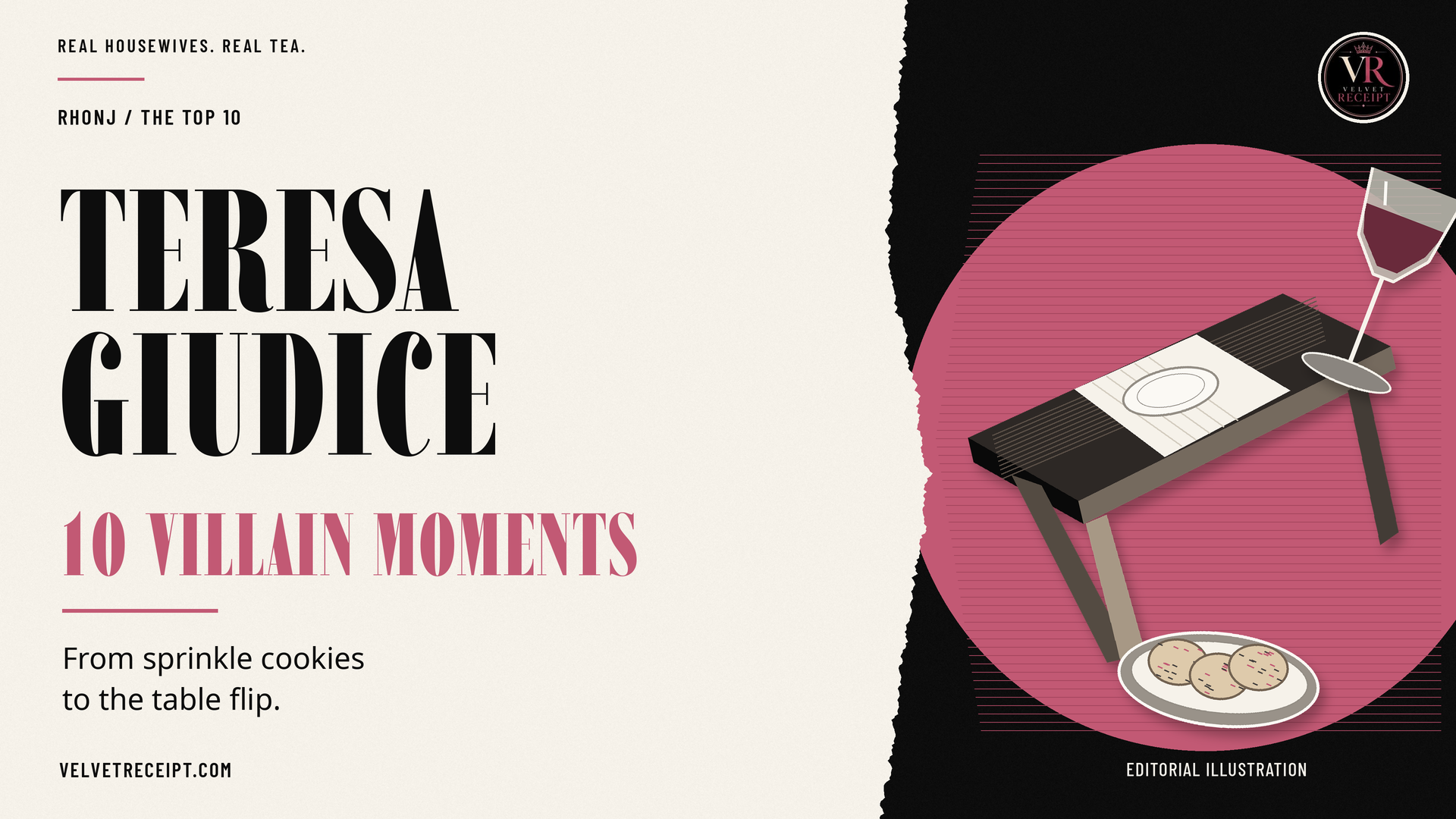
Teresa Giudice can make a plate of cookies feel like evidence in a family trial. That is part of her extraordinary value to The Real Housewives of New Jersey, and part of the problem when a slight becomes permission to humiliate somebody else.
Jump to a ranked entry
This countdown uses “villain” as a television role, not a verdict on her entire life. The ranking weighs what happened on screen, how far the response escalated, and how much the moment changed the show. An unforgettable scene does not automatically mean defensible behavior. Sometimes it means the camera was exceptionally fortunate and the person across the table was not.
From petty hospitality policing to physical intimidation, these ten scenes show how quickly a Teresa grievance can become everybody’s problem.
10. Turning sprinkle cookies into a public indictment
Season 3: the dinner-table retelling. Teresa told her friends that Melissa Gorga had brought sprinkle cookies to her home and that she had thrown them away. The on-screen moment is Teresa recounting the incident, not footage of a secret camera inside the kitchen bin. Starcasm’s account of the Season 3 scene places it in Episode 4.
What makes this excellent low-stakes villain television is the confidence that everyone should understand the offense. A guest brought dessert. Teresa presented the wrong dessert as a breach of an unwritten family constitution. Her preference for pignoli cookies somehow became Melissa’s responsibility to anticipate.
Nobody needs to pretend this belongs in the same moral category as the physical incidents below. It earns its place because it captures a particular relationship dynamic so efficiently: a small gesture can become a referendum on whether Melissa respects Teresa enough. The cookies were practically wearing tiny witness-protection sunglasses.
There was eventually a lighter sequel. Teresa and Melissa joked about the feud on a later episode, as Us Weekly reported in 2019. The original retelling remains a master class in making hospitality sound exhausting.
9. Serving cookbook shade and calling it a joke
Season 3 finale: the Fabulicious fallout. Teresa’s cookbook digs, including the comparison of Caroline Manzo’s Italian identity to Olive Garden, landed badly with the cast. E!’s contemporary finale recap records that reaction.
A cookbook is a particularly efficient delivery system for shade. The target cannot interrupt the paragraph, and the author gets to act surprised when somebody reads it. Here, the television moment was the friends and relatives processing what Teresa had put into print. It turned a business achievement into another occasion for people close to her to wonder whether they were also material.
Teresa’s explanation deserves space: she said the Olive Garden line originated in friendly television banter and was intended humorously. Her own Bravo blog gives that account.
Intent matters, but a joke also has a recipient. The villainous edge is the expectation that somebody should absorb the slight because the person delivering it has already classified it as harmless. You can sell the cookbook. You cannot pre-order everybody’s reaction.
8. Body-shaming Caroline at the reunion
Season 4 reunion. During her argument with Caroline, Teresa attacked her weight and appearance. E!’s reunion report documented the insults.
Reunions are supposed to be adversarial. Nobody expects a three-part customer-satisfaction survey. But appearance insults are the point where a dispute about what someone did collapses into an attempt to make them feel physically unacceptable. Whatever Caroline had said that season, her body was not a rebuttal.
The moment also exposes the weakness beneath this kind of verbal attack. When the argument cannot be won on its own terms, the speaker moves to a subject on which the other person might be more vulnerable. It is sharp television, but blunt reasoning.
There is a meaningful later qualification: Teresa expressed regret when the incident was revisited on Watch What Happens Live, according to Reality Tea’s report of that appearance. That acknowledgment belongs beside the original scene. A retrospective should preserve a bad moment without freezing somebody permanently inside it.
7. Escalating the Kim D. showdown at Posche
Season 8, Episode 9. Teresa confronted Kim DePaola at the Posche fashion show over gossip about her marriage. Insults escalated; Kim pushed a chair toward Teresa, and Teresa pushed it back. TV Insider’s episode recap supplies that sequence.
Kim was hardly an innocent bystander to the dispute. Her willingness to circulate the gossip was precisely why Teresa arrived angry. A fair account cannot airbrush out the provocation and present Teresa as somebody who wandered into a fashion show looking for furniture to threaten.
Still, confronting a rumor and escalating a confrontation are different choices. Teresa’s anger became a performance of intimidation, with the room reorganizing itself around the possibility of another explosion. The fashion was suddenly the least important thing at the fashion show.
This ranks below the later entries because the provocation was explicit and the chair exchange was mutual. It belongs because the scene demonstrates a recurring Teresa problem: a legitimate grievance can become much harder to defend once the response takes over the room.
6. Chasing Danielle through the country club
Season 2: the Posche aftermath. Teresa’s argument with Danielle Staub escalated into a chase through the country club. TV Insider’s retrospective identifies the pursuit as one of the show’s defining confrontations.
A fight changes character when one person is trying to leave and another keeps following. That is what gives this scene its uncomfortable charge. The exchange no longer depends on two people choosing to argue in the same place. Leaving becomes part of the conflict.
The surrounding chaos included Ashlee Holmes pulling Danielle’s hair. Teresa’s pursuit and Ashlee’s action should not be merged into a single invented act by Teresa. Bravo’s episode description confirms that the confrontation ultimately involved police.
Danielle could be provocative, theatrical and infuriating without forfeiting the right to get away from an argument. That distinction is essential here. The scene is memorable because the disagreement spilled into a pursuit, not because Danielle somehow owed everybody one more round.
The table flip had already made Teresa formidable television. This encounter made the possibility of escalation feel less like a one-off.
5. Sweeping drinks toward Margaret in Nashville
Season 12: the Nashville dinner. Teresa accused Margaret Josephs of feeding information about Luis Ruelas to bloggers. Margaret rejected the accusation, and Teresa swept drinks across the table toward her. Us Weekly’s reporting, including Traci Lynn Johnson’s eyewitness account, describes the confrontation.
The allegation about Margaret was Teresa’s claim, not an established finding. That distinction matters because the physical response can make the accusation feel more proven than it was. Anger is powerful television evidence of how somebody feels. It is not evidence that their theory is correct.
Teresa later explained that she felt protective of Luis and hurt by the scrutiny around him. Her Entertainment Weekly interview gives that perspective. Protectiveness helps explain the emotional stakes; it does not make a dining companion responsible for absorbing flying drinks.
A later apology to the group also did not immediately repair the personal rupture with Margaret, as Us Weekly’s follow-up reported. That is the consequence underneath the spectacle: once dinner becomes physically threatening, moving on requires more than ordering another round.
4. Spreading the Evan rumor at his birthday party
Season 11 premiere. Teresa circulated an unsubstantiated cheating allegation about Evan Goldschneider at his own birthday celebration. Jackie disputed it. Entertainment Tonight’s interview with Teresa records both the party behavior and Teresa’s defense of it.
The setting is what makes this particularly brutal. A birthday party comes with a built-in audience of people gathered to celebrate the subject. Turning that audience into a rumor-distribution network gives the allegation a social reach before the person affected has even had a fair chance to answer.
Teresa said she wanted Jackie to know what was being said and denied planning an attack. She also acknowledged that a private conversation could have happened instead. The editorial objection is the public choice, not a claim that we can read her mind.
Nor does Jackie’s later response retroactively verify the rumor. A person can handle being hurt badly without making the original allegation true.
Teresa subsequently named this as a moment she would redo in Us Weekly’s collection of Bravo stars’ regrets. It is an important concession about a scene where gossip was delivered with the efficiency of table service.
3. Encouraging Danielle to pull Margaret’s hair
Season 10: the boutique footage. After Danielle said Teresa had encouraged her to pull Margaret’s hair, previously unseen footage supported her account. Hollywood Life’s contemporary recap describes the reveal. Bravo also documented Teresa’s encouragement.
This is the rare Housewives twist that changes the audience’s understanding of an action already watched. Teresa had not physically pulled Margaret’s hair. Danielle had. But the footage complicated any version in which Teresa was merely nearby while somebody else made a terrible decision.
The wider fight involved antagonism and escalation on more than one side. None of that turns urging a friend toward physical retaliation into neutral companionship. Loyalty is not improved by giving the worst idea in the room a little encouragement.
Teresa later said she had not intended Margaret to be hurt and acknowledged encouraging Danielle while thinking about the television moment. She also listed the incident among her regrets in the Us Weekly interview cited above.
That television calculation is precisely what makes the scene so chilling in retrospect. The distance between making good reality TV and making somebody else unsafe should be much wider than a whispered suggestion.
2. Shoving Andy Cohen back into his chair
Season 2 reunion. Danielle’s question about Teresa acknowledging her nephew triggered an explosive response. Teresa moved toward Danielle, and when Andy Cohen intervened, she pushed him back into his chair. TV Insider’s retrospective recounts the sequence.
The host is usually the person asking why things got out of hand. Here he became part of the demonstration. The moment punctured the idea that a reunion set could safely contain whatever the season had produced.
Teresa later explained that she believed Danielle had been digging into her extended family, according to her contemporary comments to Us Weekly. She also apologized for pushing Andy. Her explanation shows why the question landed as more than casual curiosity, without making him responsible for the provocation.
The scene sits this high because the escalation was so immediate and so physical. There was no time for the reunion’s usual machinery of follow-up questions, rebuttals and receipt production. A family grievance arrived, and the moderator was suddenly trying to stay seated.
It is extraordinary footage. It is also a useful reminder that “iconic” describes cultural staying power, not acceptable treatment of another person.
1. The table flip that changed Teresa’s place in the show
Season 1 finale. At dinner, Danielle brought out Cop Without a Badge to confront the women about discussion of her past. The argument culminated in Teresa flipping the table and hurling a sexual insult at her. TIME’s account, including producer Carlos King’s recollections, traces the scene’s impact.
The insult is not a factual description we need to endorse. It was part of an aggressive outburst aimed at a woman already defending herself against a group. Danielle’s decision to force the conversation does not transfer responsibility for Teresa’s response to her.
This remains number one because the action tells the whole story even without dialogue: a social gathering stops being a conversation, and one person heaves its table upward. The table was supposed to keep everyone together. Teresa turned it into the reason everyone had to react.
There are more calculated moments elsewhere on this list, and incidents with more complicated aftermaths. None expresses Teresa’s television volatility as instantly. The scene created a shorthand that later confrontations would inevitably be measured against.
The catch is that a signature moment can become a very flattering disguise for a bad one. We can recognize why this transformed Housewives television while remembering what made it shocking in the first place.
The pattern behind the explosions
The smallest moments and the largest share a tension: Teresa often treats a perceived slight as something the whole room needs to understand immediately. At one end, that produces a bizarre dessert dispute. At the other, somebody else has to dodge the response.
Her explanations and regrets belong in the record. So do the reactions of the people affected. The strongest way to watch these scenes is to hold both, rather than letting affection for an enduring reality star settle every argument in advance. For more franchise countdowns, browse Velvet Receipt’s Lists archive.
Teresa Giudice Villain Moments FAQ
What is Teresa Giudice’s most famous RHONJ villain moment?
The Season 1 finale table flip takes our top spot. It combines immediate visual impact with lasting significance for how Teresa is discussed as a reality-TV personality. That ranking is an editorial judgment, not a claim that fame makes the behavior admirable.
Did Teresa actually pull Margaret Josephs’ hair?
No. Danielle Staub physically pulled Margaret’s hair. The separate revelation was that Teresa encouraged Danielle, which the show supported with footage. Keeping those responsibilities distinct avoids both falsely attributing the assault to Teresa and minimizing her involvement.
Was the rumor about Evan Goldschneider proven?
The cheating allegation Teresa circulated was not established by the cited reporting, and Jackie disputed it. This article ranks Teresa’s decision to spread the allegation at Evan’s party. It does not treat the allegation as a fact about his marriage.
Did the sprinkle-cookie disposal happen on camera?
The famous Season 3 scene is Teresa telling the group she threw Melissa’s cookies away. Describing the filmed retelling is more accurate than implying viewers watched the disposal itself. The appeal of the scene lies in how seriously she presented such a small domestic grievance.
Did Teresa apologize or express regret for any of these moments?
Yes. The reporting linked above records regret about the Caroline body-shaming, the Evan rumor and encouraging Danielle’s hair pull. Other incidents involved explanations or apologies that did not necessarily resolve the dispute. Those are different developments and should not be collapsed into a blanket claim that everything was either forgiven or never addressed.