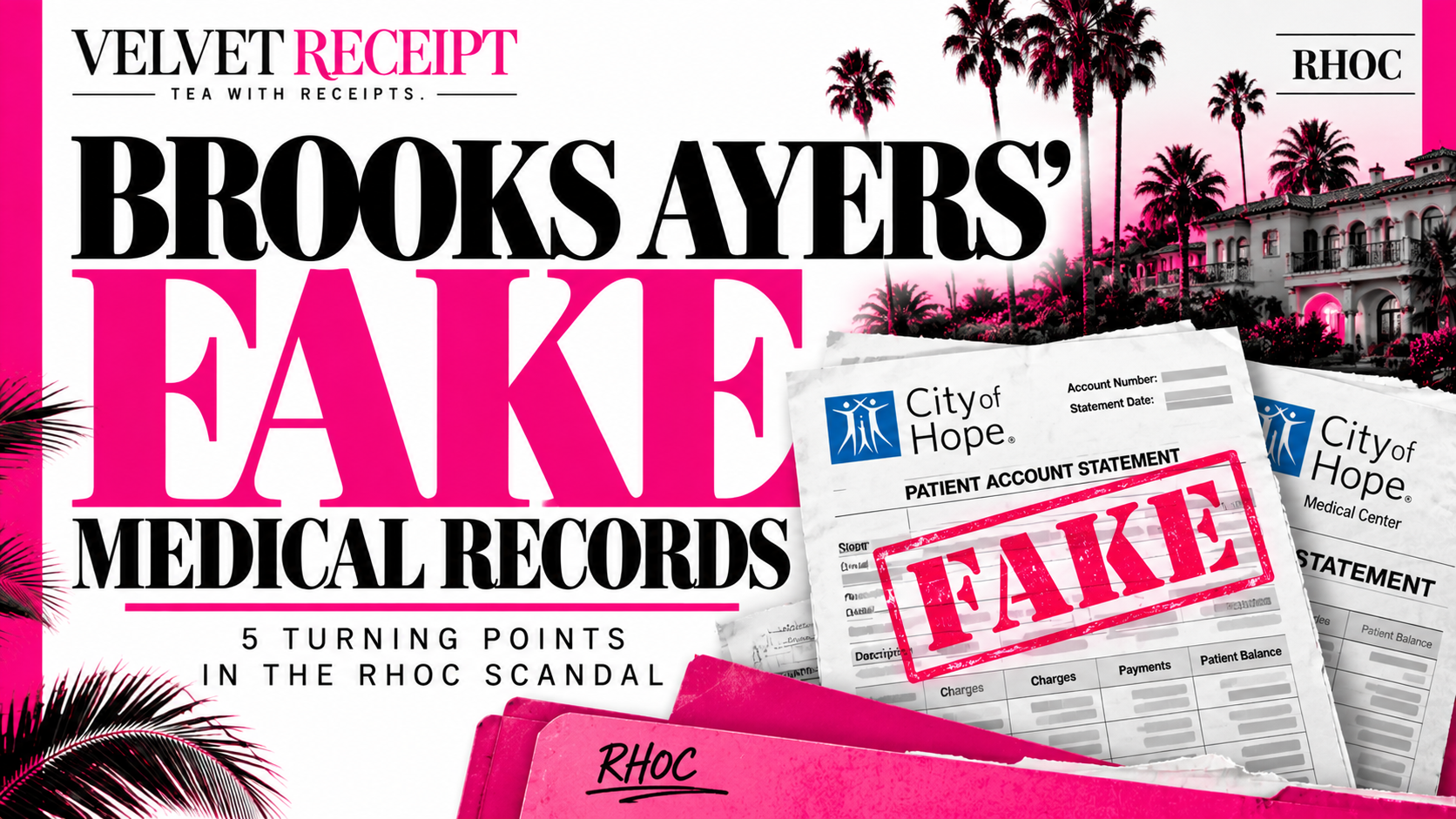
Brooks Ayers admitted on November 11, 2015, that he had fabricated medical documents presented to support his claims about cancer treatment. That admission is the verified center of one of *The Real Housewives of Orange County*’s most consequential controversies. It was an admission about paperwork, not an admission that he had never had cancer. Brooks continued to say he had cancer, and the distinction matters. [Source: Us Weekly, November 11, 2015](https://www.usmagazine.com/celebrity-news/news/brooks-ayers-confesses-to-lying-about-cancer-documents-20151111/).
For much of RHOC Season 10, the question of whether Vicki Gunvalson’s then-boyfriend was telling the truth became a test of the entire cast’s loyalties. Meghan King asked questions. Vicki defended Brooks and challenged the skeptics. Friends tried to decide what they could reasonably believe. By November, the documents Brooks had offered to quiet the doubts became the clearest evidence of deception in the public record.
There is a reason this scandal still deserves a careful retrospective. The loudest version of the story often collapses three separate questions into one: Were the records authentic? Was Brooks treated at the named hospital? Did Brooks have cancer at all? Those questions are related, but they are not interchangeable. The first was answered by Brooks himself. The second drew a specific hospital response. The third was never resolved by those two facts alone.
Here are five turning points, arranged in the order the story unfolded, with the later interviews clearly marked as hindsight rather than slipped into the 2015 timeline.
#5: Meghan King Starts Asking Questions
The Season 10 newcomer who did not accept the easy answer
When Meghan King joined the Orange County ensemble, she did not arrive with a medical investigation as her planned storyline. According to her own account, she initially expected to connect with Vicki because cancer was affecting someone close to Meghan’s family. Meghan was supporting LeAnn, the former wife of her then-husband Jim Edmonds, during LeAnn’s illness. She thought that shared experience could open a conversation.
Instead, Meghan said she encountered defensiveness. In an August 14, 2017 interview revisiting Season 10, she told Bravo that Vicki’s reaction to ordinary questions about treatment was what prompted her to look more closely. That is Meghan’s retrospective explanation, not a contemporaneous confession from Vicki about her intentions. [Source: Bravo, August 14, 2017](https://www.bravotv.com/the-daily-dish/why-did-meghan-king-edmonds-research-brooks-medical-history-in-the-first-place).
The distinction matters because a reality-TV scene can make a skeptical newcomer appear either intrusive or unusually perceptive, depending on the viewer’s sympathies. Meghan was questioning someone else’s reported illness, an inherently sensitive subject. Vicki was navigating questions about a partner she had publicly supported. Neither dynamic makes the subsequent evidence disappear.
Meghan later said other cast members had also noticed inconsistencies. Her questions did not amount to a medical diagnosis; they were an attempt to reconcile the explanations being offered. What started as a cast disagreement about boundaries and trust would eventually be tested against documents rather than opinions.
Why it mattered
Meghan changed the shape of the story. Instead of asking whether she liked Brooks, she asked what could be checked. RHOC had plenty of history with accusations and grudges, but this storyline would ultimately hinge on something more concrete than who had the sharper reunion comeback.
The questions also placed Vicki in an increasingly difficult position. Loyalty to a partner is understandable. Defending a partner’s account as if loyalty itself proves the account is accurate is another matter. Season 10 kept pushing that difference into the spotlight.
#4: Vicki’s Reunion Remarks Reveal Uncertainty
October 2015 reunion, reported November 2
By the Season 10 reunion, the skepticism was no longer confined to Meghan. The cast had spent months confronting conflicting stories and debating what Brooks had or had not demonstrated about his treatment. Vicki, who had repeatedly defended him, faced questions about what she actually knew firsthand.
In reporting published November 2, 2015, UPI described Vicki acknowledging that she had not personally verified key aspects of Brooks’ treatment and addressing statements she had made during the season. The important point is not to convert a provocative headline into a broader admission. Vicki’s remarks about what she had witnessed, repeated or failed to verify were not a medical finding that Brooks had never had cancer. [Source: UPI, November 2, 2015](https://www.upi.com/Entertainment_News/2015/11/02/Real-Housewives-Vicki-Gunvalson-admits-lying-about-Brooks-Ayers-cancer/5631446479154/).
That gap between firsthand knowledge and public certainty was the reunion’s essential tension. Vicki was not a doctor or a hospital records custodian. She was a partner who had taken a public position, then found herself being asked which parts of that position rested on things she had actually seen.
For viewers, it was a jarring turn. Vicki had been the franchise’s longest-standing cast member and one of its most forceful personalities. She was accustomed to demanding accountability from others. Now she was being asked to apply the same standard to the person closest to her.
What the reunion did and did not establish
The reunion established that Vicki’s certainty had limits. It did not prove what she privately believed at every moment, nor did it establish that she had participated in fabricating documents. Her later denials of a cover-up should be reported as her position, not converted into a definitive finding about what she knew.
There is a human element here that deserves more than a punchline. Admitting uncertainty on national television can be humiliating, especially after defending someone fiercely. But uncertainty is also the point at which responsible reporting must stop treating confidence as evidence.
#3: Brooks Presents Purported City of Hope Bills
November 2015: The interview intended to settle the doubts
As the Season 10 controversy continued beyond the reunion, Brooks gave an interview to E! News in early November 2015. During that interview, he presented documents described as bills associated with treatment at City of Hope, a California cancer center. UPI covered his defense of his claimed diagnosis on November 4, 2015. [Source: UPI, November 4, 2015](https://www.upi.com/Entertainment_News/2015/11/04/Housewives-Vicki-Gunvalsons-ex-Brooks-Ayers-defends-cancer-diagnosis/7581446646851/).
The documents mattered because they were not simply another cast member’s memory of a conversation. They purported to be records from an institution whose name could be checked. That changed the burden of the public argument. Once paperwork was offered as corroboration, its authenticity became a fair and central question.
According to contemporaneous reporting, the paperwork included charges represented as relating to cancer treatment. At this stage, those were purported bills. Calling them verified hospital records would incorrectly adopt the claim they were being used to support.
Brooks had an understandable privacy interest in his medical information. People do not owe reality-TV audiences unrestricted access to their health records. But privacy and proof are different choices. Someone can decline to release medical information; someone cannot reasonably expect fabricated documents to function as authentic evidence.
The mistake that transformed the scandal
Until this point, the story could be framed as a combustible argument among castmates over inconsistent accounts. The presentation of purported hospital bills created a more direct test: did the institution recognize the treatment history being represented?
That is the unusual twist at the heart of this retrospective. The paperwork was offered to end the debate. Instead, it supplied a new, independently checkable part of the debate.
#2: City of Hope Responds
November 10, 2015: A narrow but decisive statement
On November 10, 2015, a City of Hope representative told *Us Weekly* that the institution had no record of treating a patient under the name David Brooks Ayers. The hospital response concerned treatment at City of Hope, not every possible provider or location. [Source: Us Weekly’s contemporaneous reporting](https://www.usmagazine.com/celebrity-news/news/brooks-ayers-never-treated-cancer-here-hospital-rep-says-20151011/).
This is precisely where a careful article must resist the temptation to overstate the evidence. A statement that someone was not treated at one named hospital is not the same as a medical determination about whether that person ever had a disease. The hospital was speaking to its own records and the claim connected to its name.
Still, the response was significant. Brooks had presented documents purporting to originate from that hospital. If the institution could not substantiate the represented treatment, the documents could no longer simply be treated as reassuring proof.
For RHOC viewers who had watched a season of accusations, this was a different category of information. It was not another confessional, another dinner-table confrontation or another cast member demanding that Vicki choose a side. It was an external institutional response to a specific assertion.
Why the response changed the conversation
The public discussion shifted from whether Meghan had been too aggressive to whether the records themselves could withstand scrutiny. Those are separate editorial questions. Meghan’s approach could be debated. The hospital’s response still had to be accounted for.
The statement also sharpened the issue for Vicki. Her personal trust in Brooks was not a substitute for institutional confirmation. At the same time, the public record did not establish that she had created, altered or supplied the documents. The strongest version of the story is the one that preserves those boundaries.
The next day, Brooks made the distinction unavoidable.
#1: Brooks Admits Fabricating the Documents
November 11, 2015: The admission that settled the paperwork question
On November 11, 2015, Brooks issued a statement to E! News admitting that he had fabricated documents. He apologized for presenting false paperwork and described the decision as wrong. *Us Weekly* published the admission the same day. [Source: Us Weekly, November 11, 2015](https://www.usmagazine.com/celebrity-news/news/brooks-ayers-confesses-to-lying-about-cancer-documents-20151111/).
That is the clearest verified fact in the entire scandal. The purported City of Hope documentation was not authentic, by Brooks’ own account. No amount of debate about the cast’s tone or motives changes that admission.
Brooks said he had acted alone and without Vicki’s knowledge. He also said he had not wanted to reveal his actual medical records and had chosen false documents to quiet doubts about his story. Those were his explanations. The admission confirms fabrication; his account of his motives and Vicki’s knowledge remains attributed to him.
Crucially, he did not say he had never had cancer. He continued asserting that he had the disease. Reporting his document fabrication as a confession to faking a cancer diagnosis would go beyond the admission itself.
Vicki separately denied helping cover up the deception. That denial belongs alongside Brooks’ statement, without treating either person’s account of private knowledge as independently verified.
The receipts became the scandal
The irony is stark. For months, RHOC’s cast had been arguing about whether the people closest to Brooks were asking enough questions. Then Brooks provided material that seemed designed to answer them. The material became a fresh source of scrutiny, and he ultimately acknowledged that it was false.
There is no need to invent a hidden mastermind or a medical conclusion to explain why the incident became so memorable. Fabricated documentation is itself consequential. It can damage trust in the person presenting it, undermine the credibility of earlier claims and cause collateral harm to people who defended those claims in good faith.
For Vicki, the fallout was deeply personal and highly public. She and Brooks had split in August 2015, before the November admission. Their relationship had already become a defining part of Season 10, and the document revelation reframed the season’s arguments for viewers looking back.
For Meghan, the development gave the investigation she described a new context. It did not make every suspicion voiced by every cast member automatically correct. It did show why asking for evidence was different from simply repeating rumors.
Later statements are not part of the 2015 timeline
In a March 2016 interview with *Entertainment Tonight*, Brooks again discussed the cancer controversy and the relationship’s breakdown. That later interview is relevant to how he defended his account afterward, but it should not be presented as if he made those remarks during the November 2015 sequence. [Source: Entertainment Tonight, March 2016](https://www.etonline.com/news/185275_brooks_ayers_clears_up_cancer_speculation_says_rhoc_contributed_to_breakup_with_vicki_gunvalson).
Similarly, Meghan’s detailed explanation to Bravo in August 2017 helps explain why she pursued questions during Season 10. It is retrospective testimony, not evidence that every motive was publicly known in 2015.
That chronological discipline is essential. Housewives history becomes less reliable when interviews from years later are blended into the original episodes without dates or context.
The Velvet Receipt: When Loyalty Collided With Evidence
The Brooks Ayers controversy remains one of RHOC’s defining scandals because it tested the difference between believing a person and verifying a claim. Vicki’s loyalty, Meghan’s skepticism and the cast’s increasingly strained friendships gave the story its emotional stakes. The hospital response and Brooks’ admission gave it its documentary turning point.
There is a temptation, especially with a story this notorious, to compress the entire season into a tidy verdict about everyone involved. That would make a punchier headline and a worse article.
What the record supports is specific: Brooks presented purported City of Hope documents, the hospital disputed the represented treatment history, and Brooks admitted fabricating the paperwork. He continued claiming to have cancer. He said Vicki was unaware of the fabrication; she separately denied participating in a cover-up. Those statements do not establish a complete account of what either knew privately.
Reality television often rewards certainty. The cast member who speaks most forcefully gets the confessional. The person who asks the sharpest question gets the reunion clip. But certainty is not proof, and doubt is not a diagnosis.
In 2015, the evidence did something more revealing than settle a Housewives argument. It showed that the receipts themselves needed checking. That is why the paperwork, intended to close the story, became the story.
Brooks Ayers’ Fake Medical Records FAQ
Did Brooks Ayers admit faking medical records?
Yes. On November 11, 2015, Brooks admitted fabricating documents presented to support his claims about cancer treatment. He apologized for the false paperwork.
Did Brooks admit he never had cancer?
No. His admission concerned fabricated documents. He continued to maintain that he had cancer. The document admission should not be described as a confession that he never had the disease.
What did City of Hope say about Brooks Ayers?
A representative said on November 10, 2015, that City of Hope had no record of treating a patient under the name David Brooks Ayers. The statement concerned that hospital, not every possible medical provider.
Why did Meghan King investigate Brooks’ claims?
In an August 2017 Bravo interview, Meghan said Vicki Gunvalson’s defensive responses to questions about treatment prompted her to look more closely. That is Meghan’s later account of her motivation.
Did Vicki Gunvalson know the records were fabricated?
Brooks said he acted without Vicki’s knowledge. Vicki separately denied helping cover up the deception. Those statements should be attributed; the public reporting cited here does not independently establish everything she knew privately.
When did the Brooks Ayers medical-records scandal happen?
The controversy developed during RHOC Season 10 in 2015. Brooks presented purported City of Hope bills in early November; a hospital representative responded November 10; Brooks admitted fabricating documents November 11.


